Nanocrystals, amorphous materials, ferrites: How to choose the magnetic core materials for high-frequency transformers?
2026-09-20
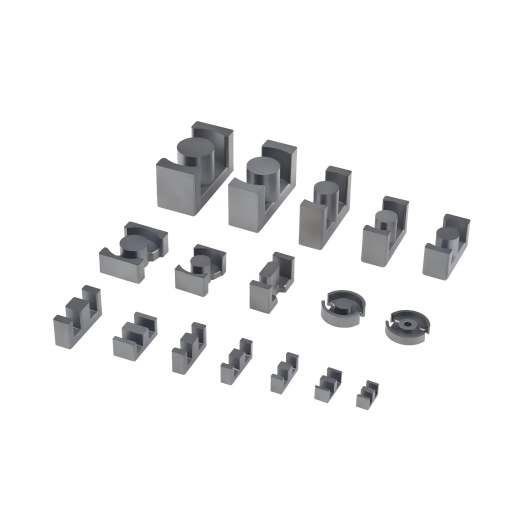
As new energy vehicles, charging stations, energy storage inverters, industrial high-frequency power supplies, and photovoltaic inverters all undergo iterative upgrades towards higher frequencies and higher power density, high-frequency transformers, as the core components for electrical energy conversion, electrical isolation, and voltage transformation, their magnetic core material selection directly determines the overall loss, temperature rise, volume, noise, and long-term reliability of the entire device. Currently, the mainstream magnetic core materials for high-frequency transformers are mainly divided into three categories: ferrites, amorphous alloys, and nanocrystals (ultrafine crystals).
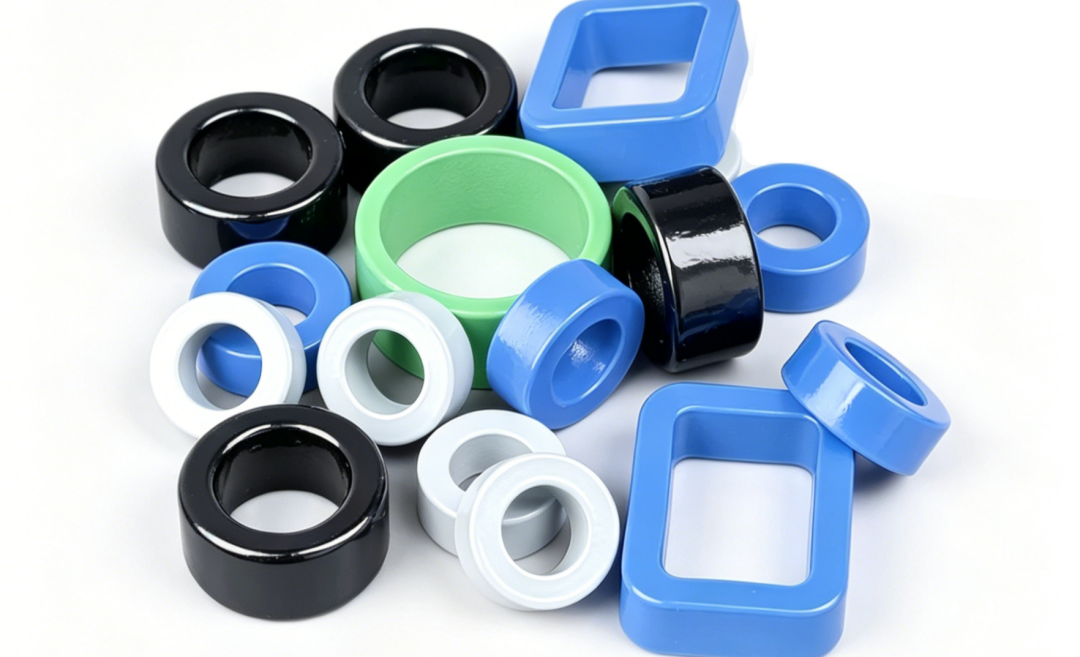
Many power supply R&D engineers often fall into the misconception that "the higher the material grade, the better", and blindly choose nanocrystals or amorphous materials, which instead leads to problems such as excessive high-frequency losses, poor partial discharge, high costs, and excessive noise. In fact, each of these three magnetic materials has its own advantages and disadvantages, and there is no absolute optimal solution; only the most suitable selection scheme for the specific application conditions exists.
- Comparison of core parameters and underlying characteristics of the three main high-frequency magnetic cores
The performance limit of high-frequency transformers is determined by five core parameters: saturation magnetic flux density, high-frequency losses, Curie temperature, magnetic permeability, and magnetic piezoelectric coefficient. The material structure differences of ferrites, amorphous alloys, and nanocrystals (ultrafine crystals) result in completely different performance manifestations in different working conditions, which are the core basis for selection.
1.Ferrite magnetic cores are the most widely used traditional high-frequency magnetic materials in the industry, mainly manganese-zinc ferrite. The saturation magnetic flux density is approximately 0.5T, which is relatively low, but it has extremely low high-frequency eddy current losses, low magnetic piezoelectric coefficient, and excellent noise control. Its Curie temperature is approximately 200℃, with moderate temperature stability, and its advantages lie in high-frequency low loss, low noise, high insulation, and affordable price, making it suitable for ultra-high frequency, lightweight, and quiet scenarios.

2.Iron-based amorphous magnetic cores belong to metal soft magnetic materials. The atomic arrangement is disordered without crystal boundaries, and the coercive force is extremely low. The saturation magnetic flux density can reach 1.2T to 1.5T, much higher than ferrites. Its Curie temperature can reach 400℃, with excellent high-temperature performance, low losses at medium and low frequencies, and significant power density advantages. However, its high-frequency eddy current losses increase rapidly, the magnetic piezoelectric coefficient is larger, and the working noise is higher. It is not suitable for ultra-high frequency conditions.
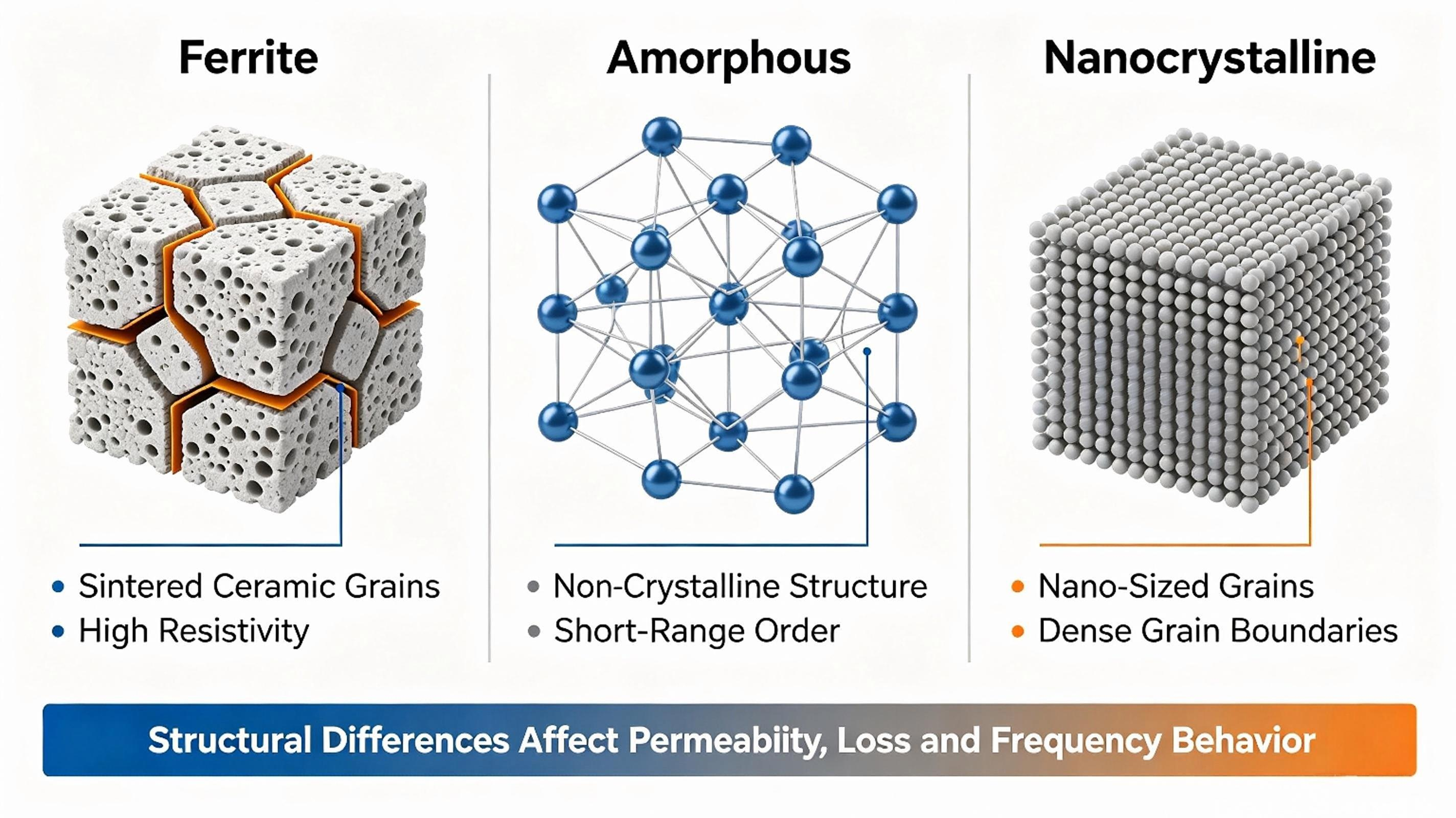
3.Iron-based nanocrystal magnetic cores are high-end composite soft magnetic materials, combining the advantages of amorphous and microcrystalline materials. The saturation magnetic flux density is approximately 1.2T, close to that of amorphous materials, and its Curie temperature is as high as 500℃ to 550℃, with extremely strong temperature stability. At the same time, its high-frequency losses are far better than those of amorphous materials, with extremely low losses in the entire medium and high-frequency range, high magnetic permeability, and good parameter consistency. The only drawback is higher costs and the tendency to produce fine burrs during the cutting process, with slightly weaker partial discharge performance compared to ferrites.
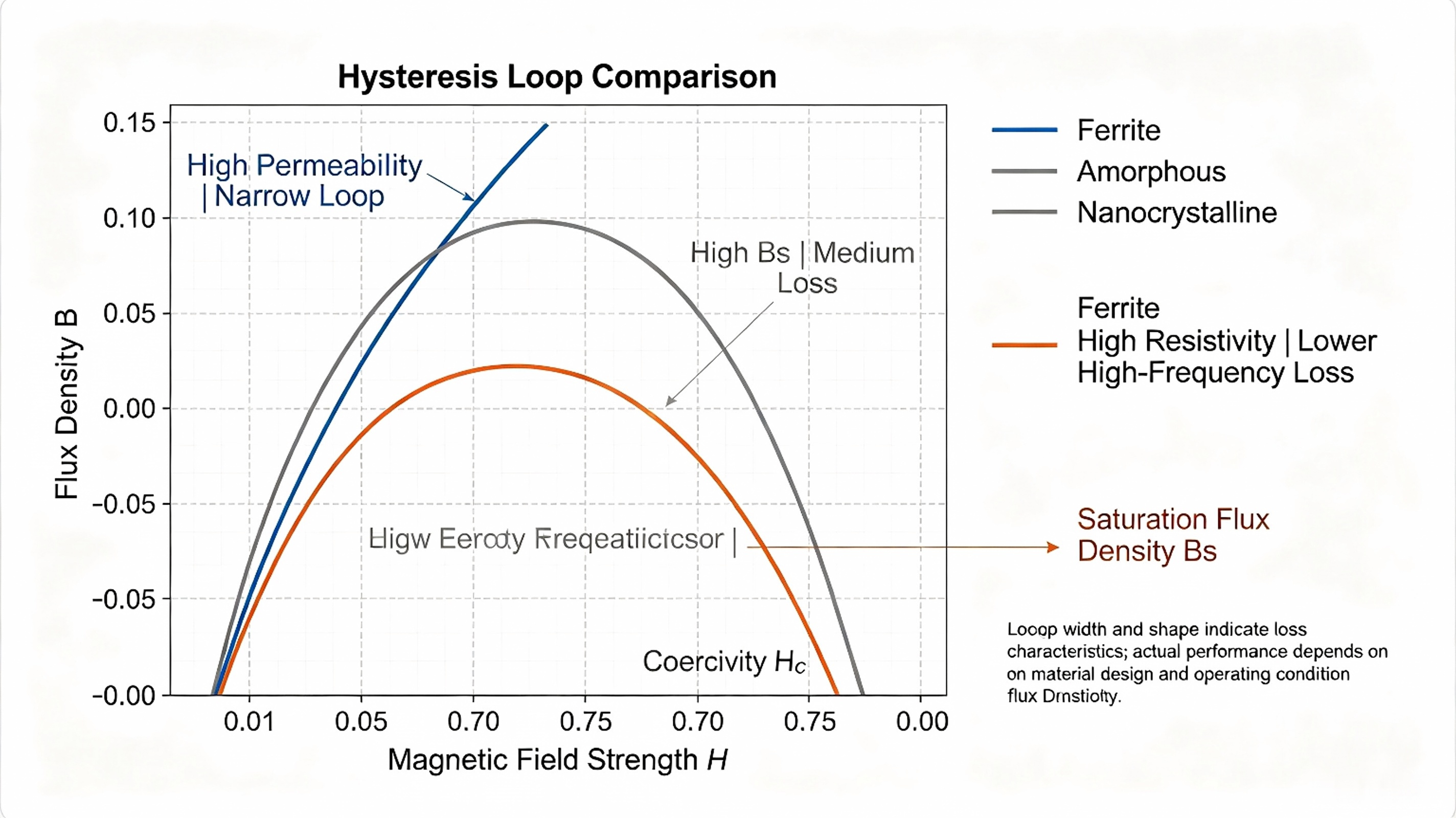
Overall, ferrites excel in low noise, high insulation, and high cost-effectiveness at high frequencies; amorphous materials excel in high saturation at medium and low frequencies, excellent high-temperature performance, and high power density; and nanocrystals excel in low losses in the entire medium and high-frequency range, strong temperature stability, and comprehensive reliability.
- Selecting by frequency band: Precisely matching magnetic materials based on switching frequency
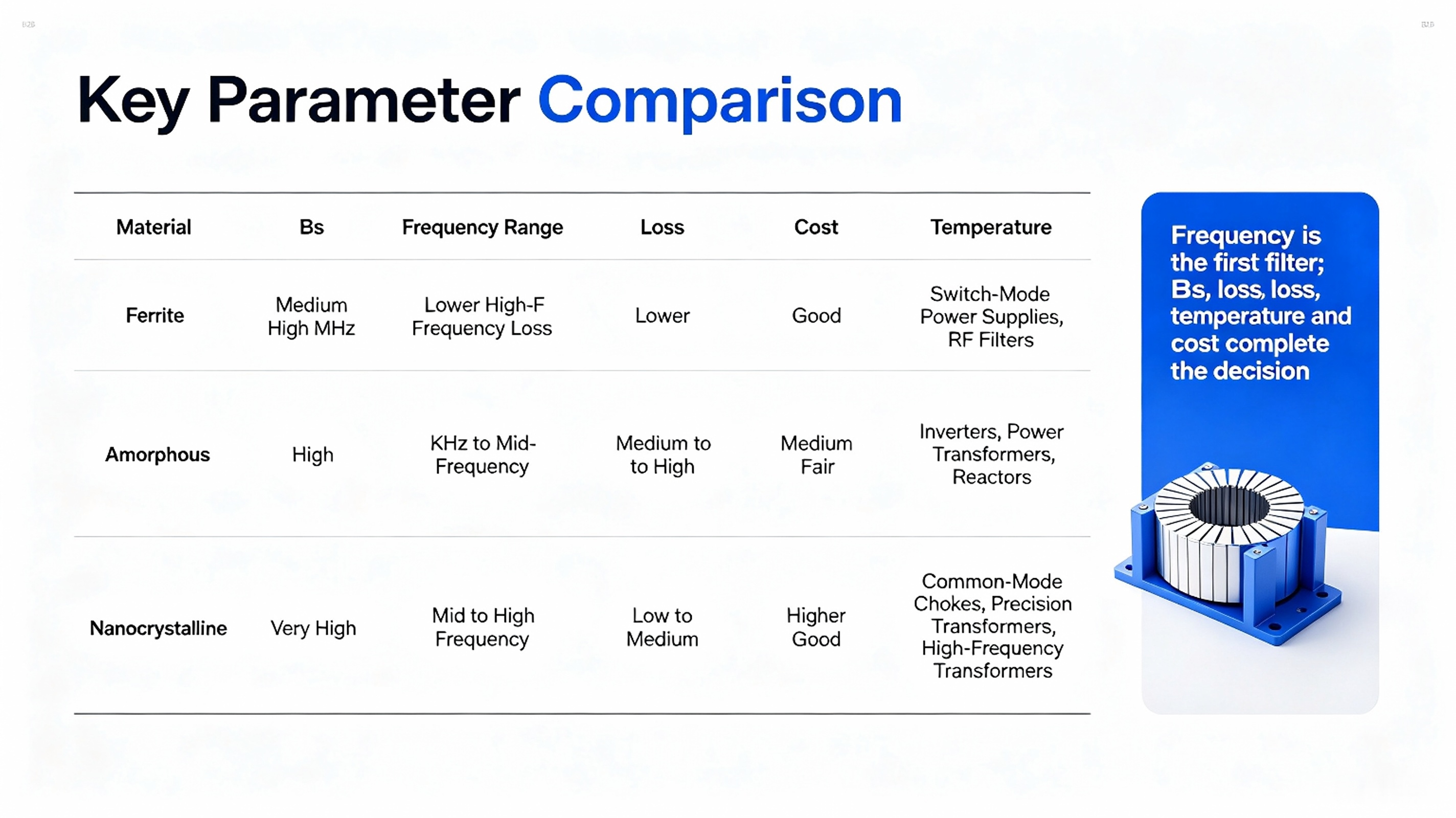
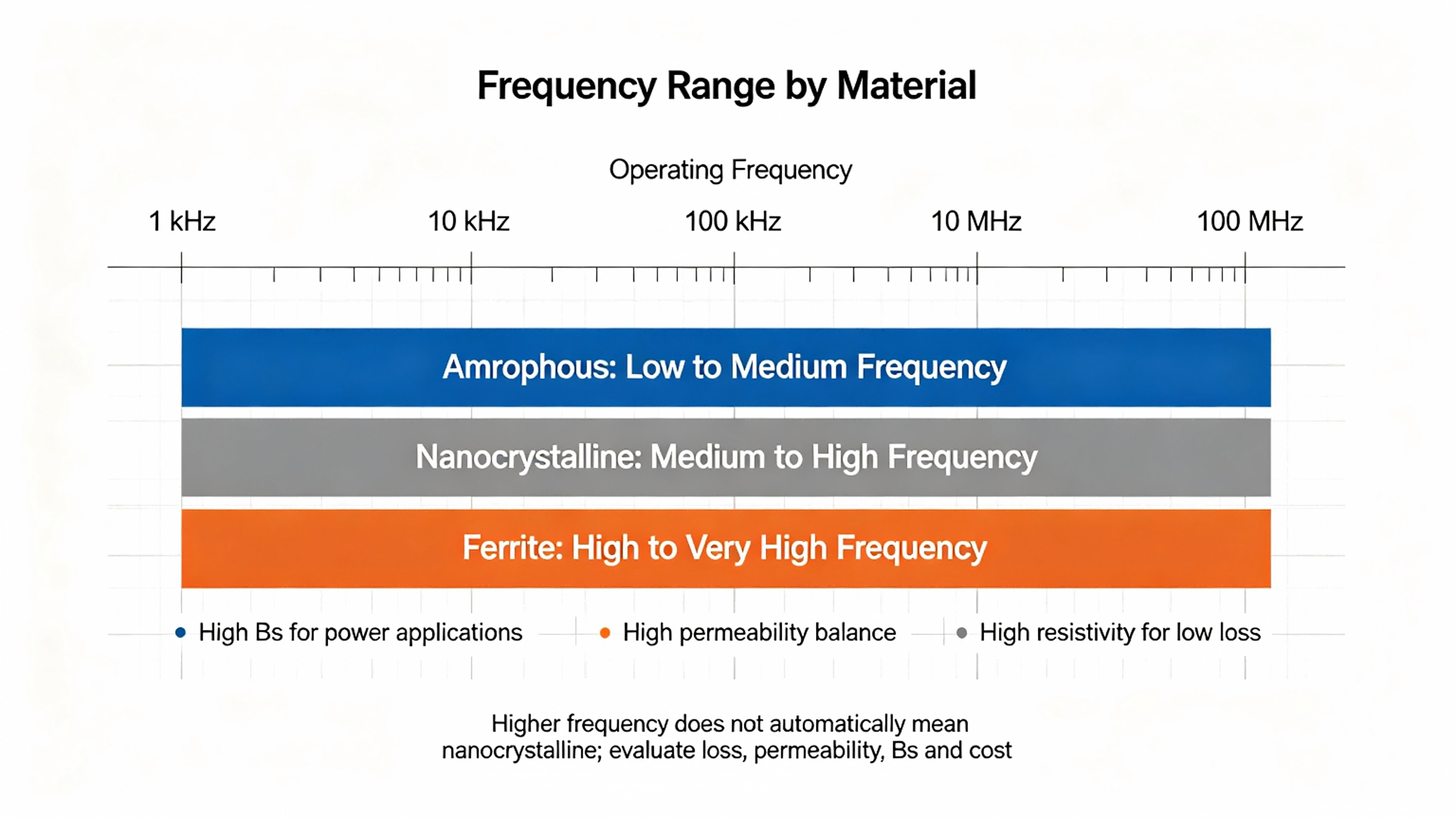
Frequency is the first priority indicator for selecting magnetic cores. The optimal working frequency range of different materials is completely different, and mismatch will directly lead to soaring losses, runaway temperature rise, and plummeting efficiency.
1. 10kHz - 100kHz: Prefer amorphous alloys
In medium and low-frequency high-power conditions, ferrite's saturation magnetic flux density is insufficient, leading to magnetic core saturation and parameter drift. To meet the power requirements, the volume of the magnetic core must be enlarged, resulting in low power density. However, amorphous alloys have high saturation magnetic flux density, strong resistance to DC bias, extremely low iron losses at medium and low frequencies, and a volume reduction of more than 30% compared to ferrite at the same power. Their high-temperature performance is outstanding, making them suitable for high-power industrial frequency inverters, energy storage converters, and medium-frequency isolation transformers and other equipment. It should be noted that after a frequency of 100kHz, amorphous material's eddy current losses increase rapidly, and it no longer has advantages.
In medium and low-frequency high-power conditions, ferrite's saturation magnetic flux density is insufficient, leading to magnetic core saturation and parameter drift. To meet the power requirements, the volume of the magnetic core must be enlarged, resulting in low power density. However, amorphous alloys have high saturation magnetic flux density, strong resistance to DC bias, extremely low iron losses at medium and low frequencies, and a volume reduction of more than 30% compared to ferrite at the same power. Their high-temperature performance is outstanding, making them suitable for high-power industrial frequency inverters, energy storage converters, and medium-frequency isolation transformers and other equipment. It should be noted that after a frequency of 100kHz, amorphous material's eddy current losses increase rapidly, and it no longer has advantages.
2. 50kHz - 200kHz: Prefer nanocrystal materials
This frequency band is the mainstream working frequency for vehicle OBCs, two-way DC-DC converters, and high-power charging module modules. Nanocrystals perfectly cover this range. Compared to amorphous materials, the high-frequency loss is significantly reduced; compared to ferrite, the saturation magnetic density is higher, the anti-saturation ability is stronger, and the temperature drift is smaller. At 100kHz operating conditions, the loss of nanocrystals is only about half of that of ferrite, which can effectively reduce the overall temperature rise and improve the conversion efficiency, making it the optimal choice for high-frequency and high-power new energy equipment.
3. Ultra-high frequency above 200kHz: Priority high-quality ferrite
When the switching frequency exceeds 200kHz and even reaches the ultra-high frequency range of 500kHz to 1MHz, the eddy current loss of metal-based magnetic materials (amorphous, nanocrystals) will increase exponentially, and the loss advantage completely disappears. While high-grade manganese zinc ferrite (brands such as 3C95, PC95, DMR95, etc.) with extremely high resistivity and extremely low high-frequency eddy current loss become the only suitable material for ultra-high frequency conditions, and at the same time, the magnetic anisotropy is smaller, the whistling noise is low, and it is suitable for small-sized high-frequency switching power supplies, ultra-high frequency resonant transformers, and signal isolation transformers scenarios.
- Selecting based on operating conditions: trade-offs of loss, temperature rise, noise, and discharge
1. Low temperature rise, high efficiency conditions
For high-power equipment that operates continuously at full load for a long time, prioritize nanocrystal magnetic cores. Their all-domain low-loss characteristics can significantly reduce steady-state temperature rise, avoiding problems of high-temperature thermal aging and efficiency decline; for medium and low-power ultra-high frequency equipment, choose high-end ferrite; for medium and low-frequency ultra-large power equipment, choose amorphous alloys.
For high-power equipment that operates continuously at full load for a long time, prioritize nanocrystal magnetic cores. Their all-domain low-loss characteristics can significantly reduce steady-state temperature rise, avoiding problems of high-temperature thermal aging and efficiency decline; for medium and low-power ultra-high frequency equipment, choose high-end ferrite; for medium and low-frequency ultra-large power equipment, choose amorphous alloys.
2. Low noise, silent conditions
For vehicle cabins, home energy storage, and indoor power equipment that are sensitive to NVH, choose ferrite. The magnetic anisotropy of amorphous and nanocrystals is greater, and the vibration amplitude under alternating magnetic fields is high, which is prone to audible whistling noise. The noise performance of the ferrite core is much better than that of the amorphous core.
3. Wide temperature, high reliability vehicle conditions
For automotive compartments with a temperature range of -40°C to 125°C, wide temperature cycling, and high-load full-load conditions, prioritize nanocrystals. Their ultra-high Curie temperature ensures stable parameters in all temperature ranges and will not experience high-temperature magnetic performance degradation or loss increase problems. The reliability of automotive-grade nanocrystals is far superior to ordinary ferrite.
4. High discharge, high insulation conditions
For high-voltage isolation, precision power supplies, and photovoltaic inverters with strict discharge index requirements, ferrite has a dense structure, a smooth surface, and good insulation performance, and has the best discharge performance; while nanocrystals have slightly weaker discharge performance due to the presence of fine burrs in the cutting process, and need additional insulation encapsulation optimization to meet the standards.
- Cost and production compatibility logic
From the cost gradient perspective: ferrite has the lowest cost and is suitable for large-scale civilian and industrial conventional power supplies; amorphous has a middle cost, suitable for medium and low-frequency high-power low-cost upgrade scenarios; nanocrystals have the highest cost and are mainly used for new energy vehicle, high-end energy storage, and high-precision high-power equipment. Simply pursuing low cost will sacrifice power density and reliability; blindly choosing high-end nanocrystals will result in performance redundancy and cost waste; the production selection must balance performance and cost.
- Common industry selection pitfalls to avoid
First, blindly using nanocrystals in high-frequency conditions, the eddy current loss of nanocrystals increases sharply above 200kHz, and it is not as stable as high-end ferrite;
Second, using ferrite in low-frequency high-power scenarios, it is prone to magnetic saturation, bulky volume, and excessive temperature rise;
Third, choosing non-ammorphous/nanocrystals for silent equipment, resulting in the overall whistling noise exceeding the standard;
Fourth, directly using nanocrystals in high-voltage discharge scenarios, without insulation optimization, resulting in test failure. Precisely matching frequency and conditions is the core principle of magnetic core selection.
- Summary
The core logic for selecting high-frequency transformer magnetic cores can be precisely summarized: low-frequency high-power select amorphous, medium-high-frequency high-reliability select nanocrystals, ultra-high-frequency low-noise select ferrite. Amorphous alloys are suitable for 10kHz to 100kHz medium-low-frequency high-power scenarios, with high saturation magnetic density and high-temperature advantages to improve power density; Nano-crystals cover the mainstream high-frequency conditions of new energy sources ranging from 50kHz to 200kHz, balancing low loss, wide temperature stability and high reliability; high-end manganese-zinc ferrite dominates the ultra-high frequency, low noise and high insulation scenarios above 200kHz, with outstanding cost-effectiveness and stability.
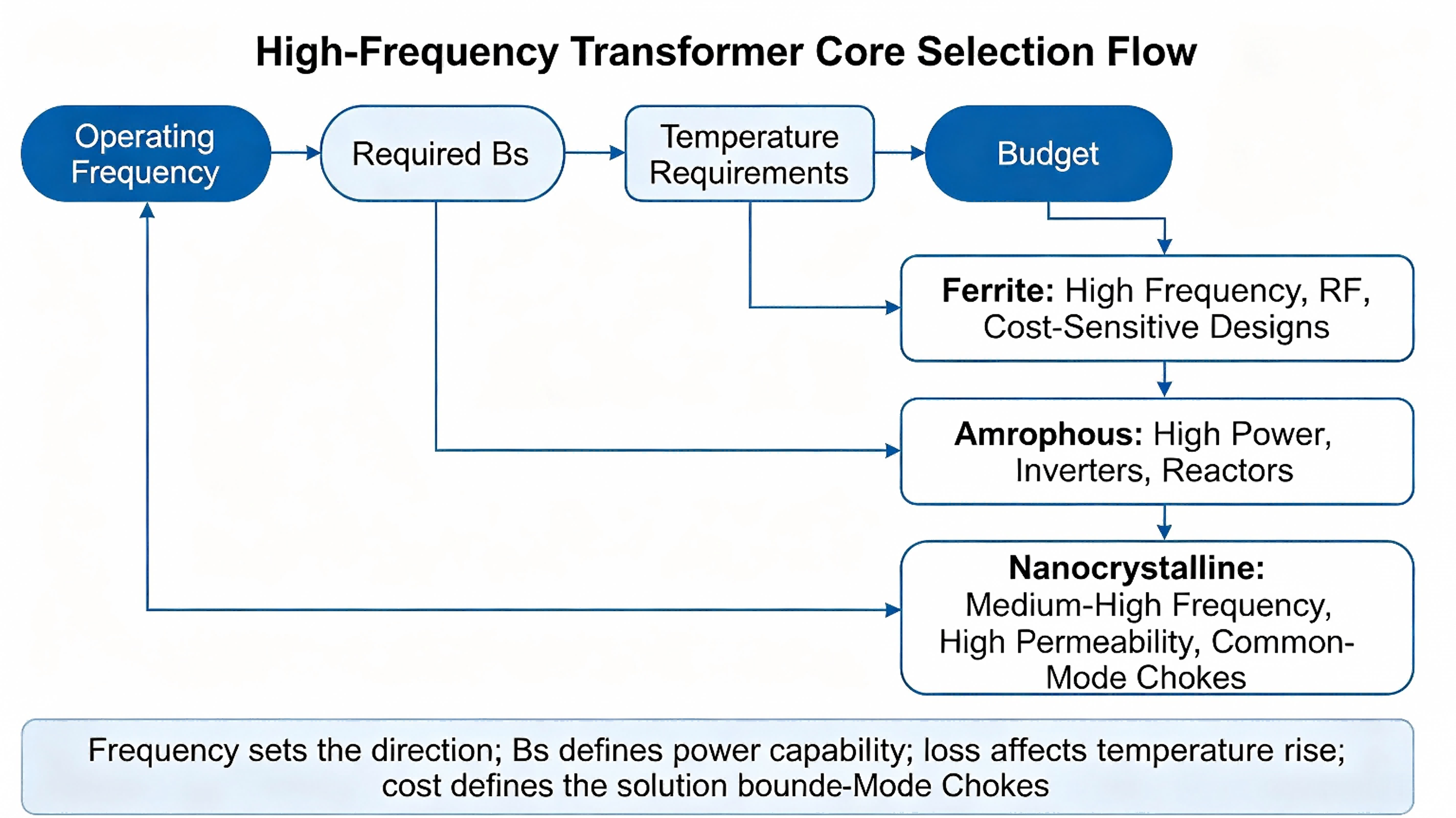
Under the industry trend of high-frequency, high-density and long lifespan in power electronic equipment, abandoning empirical selection and based on frequency, power, temperature range, noise and insulation requirements for precise matching of magnetic core materials can effectively solve industry pain points such as transformer overheating, low efficiency, high noise and poor reliability. It is the core key for the design and optimization of high-frequency power supplies and mass production.
Customization process of magnetic component products: Comprehensive analysis from drawing to sample delivery.
Related Article
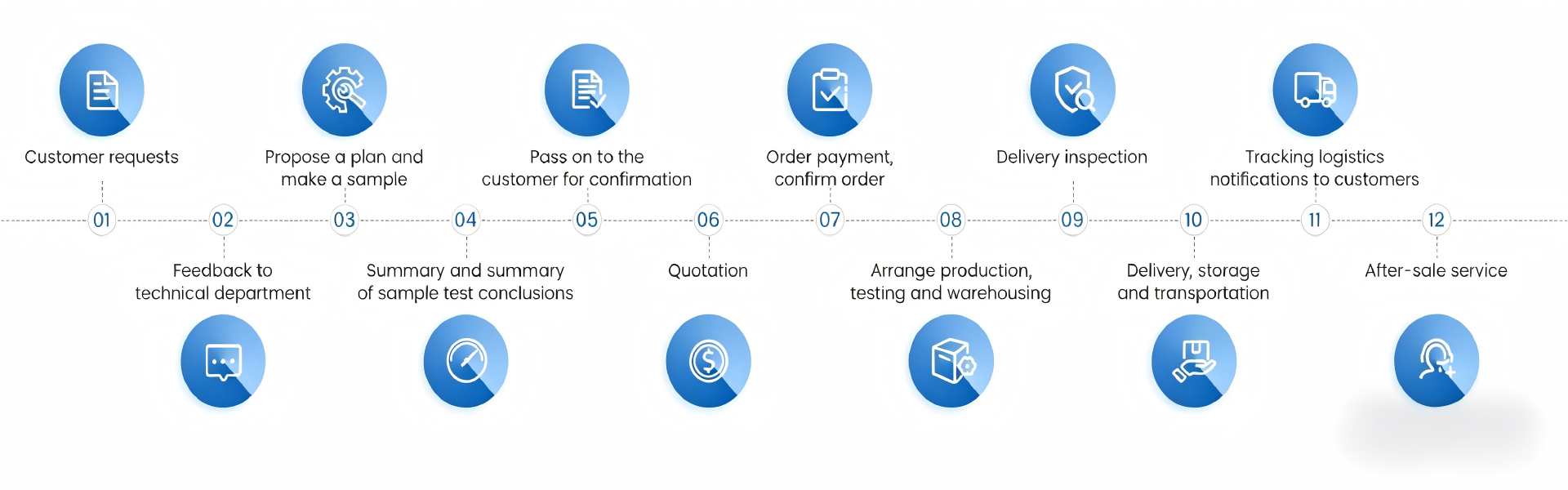
Customization of magnetic components starts with a customer providing a drawing or a set of parameters. From there, through multiple stages such as requirement communication, drawing review, material selection, winding and prototyping, tape wrapping and assembly, electrical testing, sample confirmation and packaging for shipment, the process involves numerous steps.
Customization process of magnetic component products: Comprehensive analysis from drawing to sample delivery.
Practical SMPS transformer calculation tutorial. From parameter confirmation and core selection to winding, air‑gap and thermal verification for power supply design.
How to Calculate Switching Power Supply Transformers: A Complete Method from Parameter Determination to Core Selection

Customized magnetic components are not simple parameter adjustments; they are based on full-dimensional customized design of vehicle application scenarios, operating conditions data, and automotive standards, optimizing from material formulation, magnetic circuit structure, winding process, heat dissipation structure, protection system, and durability verification, completely solving the industry pain points of poor adaptability, short lifespan, and high failure rate of standard components.
How do custom magnetic components ensure longevity in harsh automotive environments?
Unlike ordinary civil‑use power inductors, industrial‑grade inductors for charging piles need to balance anti‑saturation capability, low loss, stability over a wide temperature range, low harmonic interference and excellent heat dissipation performance.
Inductor Selection and Thermal Management Strategy in Charger Module Power Supply: High Efficiency, Stable Load, and Long-Term Reliability Solution
SEND MESSAGE